
7 Tips for Playing Harmonica with Guitar as a Beginner
Listen to this episode on:
Pick up a harmonica and start playing harmonica with guitar before you have a plan, and you'll sound like a cat walking across a keyboard. That's the moment most beginner guitarists put the harmonica down and never pick it up again. The players who pushed through it, Bob Dylan, Neil Young, Johnny Cash, all figured out early that playing harmonica alongside guitar is not about raw talent. It's a coordination skill with a very specific sequence, and once you understand the setup, the key matching, and the practice logic, the gap between "that sounds terrible" and "that sounds like a one-person band" closes faster than you'd expect.
The system behind the Harmonica with Guitar Blueprint was built around exactly this reality. After working with hundreds of beginners, the same seven sticking points come up every time. This guide walks you through all seven, in the order that matters most.
Playing harmonica with guitar: Get your gear right before you play a single note
Two equipment decisions determine whether your first practice session feels like progress or a frustrating mess. Get these wrong and coordination becomes ten times harder. Get them right and you'll feel like a real musician within the first twenty minutes.
Tip 1: Match your harmonica key to your guitar key using a capo
When starting out, I recommend playing in first position (same key as the harmonica). What if you learnt a song on a C diatonic harmonica, but you own a harmonica with a different key? The answer is simple!
Using a capo lets you match your harmonica (for example, a C diatonic) to familiar open guitar chord shapes across multiple song keys. Simply place the capo at the fret indicated below, then play the shapes listed to bring your guitar into the song's actual key with your harmonicas. Your guitar should be in standard tunning.
Here's the chart you'll use constantly as a guitarist:
| Harmonica Key | Capo fret | Chord shapes |
|---|---|---|
| C | No Capo | C, G, Am, F |
| G | No Capo | G, D, Em, C |
| D | Fret 2 | C, G, Am, F |
| A | Fret 2 | G, D, Em, C |
Start with a C diatonic harmonica. No capo covers songs in C, and a capo on fret 2 lets you tackle D tunes using the same C shapes. A starter set of C, G, D and A harmonicas plus these capo positions covers all four of these common guitar keys. This one-piece setup keeps beginners sounding confident instead of lost.
Tip 2: Set up a neck rack so your hands stay on the guitar
You physically cannot hold a harmonica and strum guitar chords at the same time. A harmonica holder, also called a neck rack, is not optional gear, it's the piece of equipment that makes playing harmonica with guitar possible in the first place. Without one, you're not playing harmonica with guitar. You're just switching between them. If you want a quick comparison of reliable options and how they fit, check this roundup of the best harmonica holders.
The Hohner FlexRack and the Seydel Farmer Gecko are two reliable options for players who want stability while strumming. To fit the rack: place the padded neck brace behind your neck, adjust the angle screws until the harmonica sits level at lip height, and test the positioning before you add strumming. Most players find a properly fitted rack feels nearly invisible after ten minutes of wear. That invisible quality is exactly what you're aiming for.
Build coordination in stages, not all at once
Most beginners try to play harmonica and guitar simultaneously the way they'd juggle two unrelated tasks. That approach fails because it overloads your attention before any automatic habits have formed. Coordination builds fastest when you shrink the unit of simultaneous action down to something almost embarrassingly small, then expand from there.
Tip 3: Start with the 3-Day approach
To avoid the frustration of trying to do too much at once, follow this structured approach:
Day 1: Mastering the Melody
The focus of the first day is strictly on the harmonica. You must be able to play the melody on your rack—not with your hands—until you can do it with your eyes closed.
- Pro Tip: Use the "poker lip" technique (shaping your lips like you're drinking from a straw) to hit clean single notes.
Day 2: Humming and Strumming
Day two shifts the focus to the guitar. Instead of playing the harmonica, hum the melody while you strum the chords. This trains your brain to coordinate the rhythm of your hands with the melody in your head.
Day 3: The Big Combo
On the final day, you bring it all together. Start at a slow tempo (around 70 BPM) and use simple downstrums to keep your timing steady.
This approach trains the hardest part of the whole setup, the coordination between breath and strum, without overwhelming your brain with melody at the same time. Boring drills done correctly beat exciting songs done sloppily every single time at this stage.
Tip 4: Breathe from your diaphragm, not your chest
Chest breathing is the number one reason beginners run out of air mid-phrase or develop tension in their shoulders. Diaphragmatic breathing, where your belly expands on both the blow and draw, produces a fuller tone and keeps your rhythm stable when you're managing two instruments at once. A simple drill: place your hand on your stomach and practice four-count blow and draw cycles until the belly movement feels completely automatic.
When your breathing is relaxed, your timing stays consistent. When it's tense, everything collapses together. Diaphragm control is not an advanced technique, it's a foundational one that pays dividends on every single note you play.
The one music theory concept you actually need
You don't need to study music theory to coordinate harmonica with guitar. You need exactly one concept, and cross-harp is it. Here's the slightly deeper version that makes everything click into place.
Tip 5: Understand second position before you try any other technique
Second position means you're playing harmonica in the key a perfect fourth above its labeled key. A C harmonica played in second position gives you the G blues scale. The draw notes become your primary tool, and because draw notes naturally carry that slightly strained, expressive blues quality, cross-harp playing sounds musical even when you're just starting out. If you want a short reference on harmonica keys and positions, see this overview of harmonica keys and positions.
Play real blues music from day one using the 12-bar blues
Drills keep you disciplined, but real music keeps you motivated. The 12-bar blues is the single best training ground for learning to combine harmonica with guitar because it repeats, it's forgiving, and it sounds instantly recognizable to anyone who hears it. The repetitive chord structure gives your brain enough cognitive bandwidth to focus on coordination rather than memorization, which is exactly what you need at this stage.
Tip 6: Use the 12-bar blues as your training ground
A 12-bar blues in G uses three chords: G, C, and D. On a C harmonica in second position, you have draw notes that match all three chord changes built right into the lower holes of the instrument. You don't need to travel far up the harp to sound musical.
Here are three beginner-friendly riffs that work immediately over a G blues, with no bending required:
- Chord rhythm riff (over G): Draw holes -1 -2 -3 together as a chord. Pulse it on beats 1 and 3 for a full, bluesy rhythm sound.
- Boogie line (works over the full progression): -2 -3 -4 5 -5 5 -4 -3 -2. Play this as a single-note run, repeating it across chord changes.
- Call-and-response lick: Draw -1 -2 together four times over the G chord (I), then blow 1 2 3 together twice as the progression moves to C (IV). Two shapes, two chords, instant blues phrasing.
Layer these riffs on top of your strumming as your confidence grows. None of them require bending, so your focus stays on maintaining the strumming pattern while the riffs lock in naturally.
Build timing with a five-stage practice sequence
Coordination between harmonica and guitar improves fastest when you follow a deliberate progression rather than randomly working through songs. The five-stage sequence below takes you from shaky first attempts to confident, performance-ready playing. Each stage builds directly on the last.
- Single blow note on beat 1 while strumming four-beat chords. Practice at 60 BPM until clean.
- Quarter-note chugging rhythm on beats 1 and 3, with a simple lick added on bar 4.
- Half-note sync over a four-chord progression, holding each harmonica note for two full beats.
- Blues triplets over eighth-note guitar strums, staying locked to the groove.
- Full 12-bar jam loop with improvised phrasing and dynamics, aiming for musical expression, not just accuracy.
Five focused minutes daily beats thirty unfocused minutes every time. Record yourself on your phone and listen back, you'll catch rushing and breath gaps that your ears miss in real time. Move to the next stage only when three consecutive clean run-throughs at your target tempo feel genuinely effortless. Rushing this process is the most common and most costly mistake beginners make.
Choose the right songs and give yourself a clear finish line
Tip 7: Pick songs with built-in rhythmic space
Not every song suits the beginner one-person band setup equally. The best starting songs leave natural pauses in the melody, giving you time to settle into a chord change before the next phrase begins. Folk, country, and slow blues songs in G or D are ideal: the chord changes are predictable, the tempos are forgiving, and the harmonica phrases naturally fall between guitar strum patterns without fighting for space.
Avoid fast, dense melodies until your coordination is locked in. Trying to force a quick song before you're ready creates frustration that has nothing to do with your actual ability, just your sequence.
Why a structured 3-day guide shortens the learning curve dramatically
Figuring out which harmonica to buy, which songs to start with, how to set up the rack, and how to sequence your practice without a roadmap takes most self-taught players months of trial and error.
When I built the "Learn Harmonica with Guitar in 3-days" blueprint, I sequenced it specifically to eliminate that guesswork. Songs are pre-paired with harmonica tabs and guitar chords, tutorial videos run karaoke-style so you can follow along in real time, and each day has a single clear goal. You skip the frustrating exploration phase entirely and go straight to making real music.
That's the difference between a weekend of genuine progress and six months of spinning your wheels on gear choices and random YouTube rabbit holes.
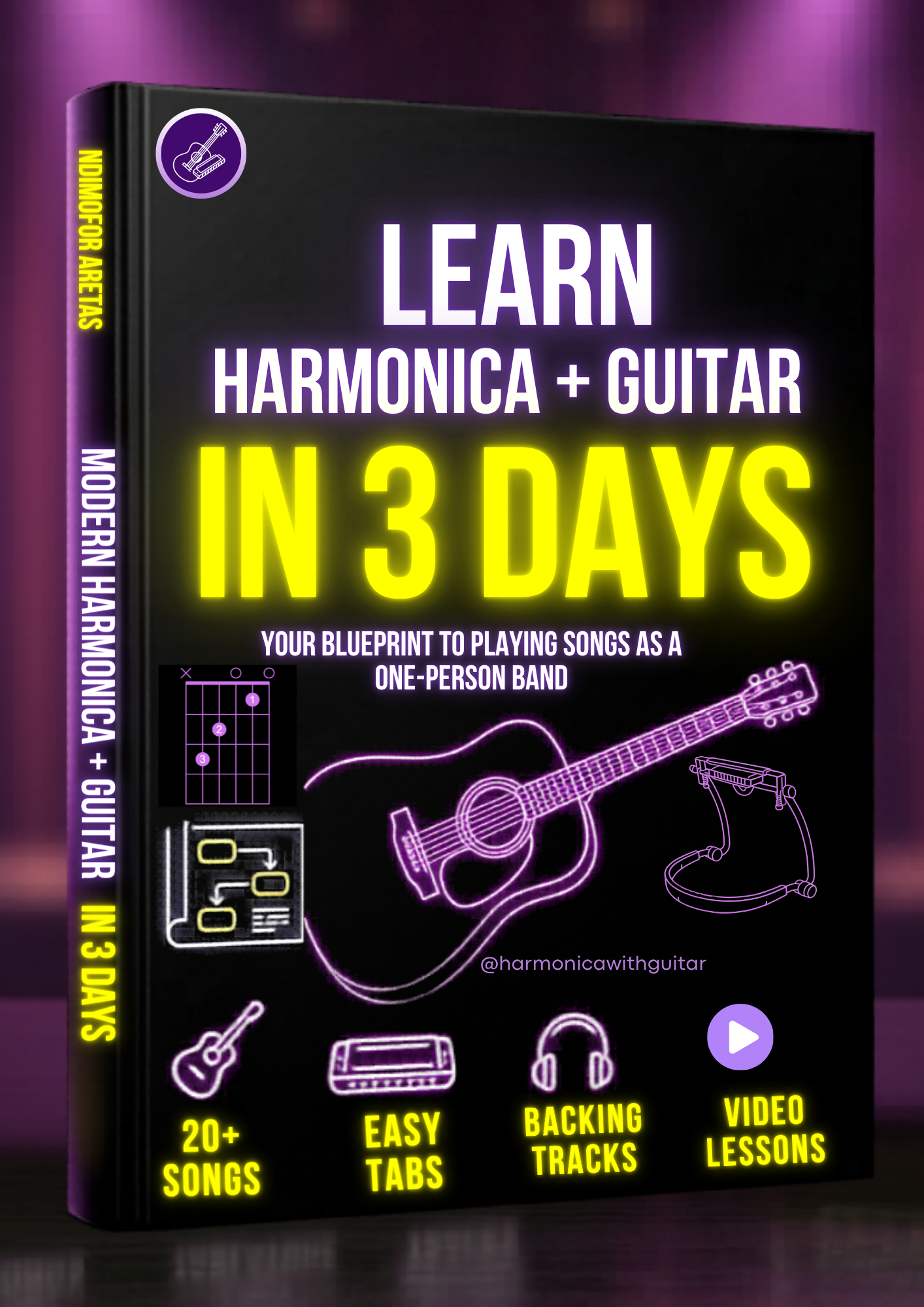
Learn Harmonica + Guitar in 3 Days. It includes:
- 20+ beginner-friendly songs,
- Downloadable backing tracks, and
- The complete coordination method.
- Lifetime access to a growing list of songs & video lessons.
Start small, build fast
Seven tips, one clear sequence. Match your harmonica key using cross-harp, set up a neck rack so your hands stay free, start with one blow note per chord, breathe from your diaphragm, master second position, use the 12-bar blues as your foundation, and choose songs that give you room to breathe.
Playing harmonica with guitar is not a talent you either have or don't. It's a coordination skill with a defined sequence, and you just walked through it. Every tip in this guide exists to reduce the number of variables you're managing at once until simultaneous playing becomes automatic. Once it clicks, it doesn't unclick. If you want a clear path from day one to your first full performance, the Harmonica with Guitar, One-Person Band Starter Kit free sample gives you your first two songs and introductory lessons at no cost.
Pick up your C harmonica, fit your neck rack, and start with that single blow note on beat 1. Everything else builds from there.
